What is factoring? Turning receivables into cash in Türkiye, with a cost example
How factoring works in Türkiye: the parties and process, recourse versus non-recourse, supply chain finance and export factoring, required documents, calculating the cost from discount, commission and taxes, comparison with bank loans and cheque discounting, and when it makes sense for startups.
By Editorial Team

You sold to a large customer and invoiced, but payment comes in 60, 90 or even 120 days. Meanwhile you must pay salaries, rent and suppliers. For startups and SMEs selling to corporates, this "term gap" is one of the biggest obstacles to growth. Factoring lets you turn receivables into cash before they fall due. This guide explains how it works in Türkiye, the types, the cost and when it makes sense.
This content is for general information, not financial advice. Costs depend on market rates, your customer's risk profile and the provider. Compare several offers.
What is factoring?
You assign receivables from sales of goods or services to a factoring company and receive part of the amount upfront; the factor collects from your customer at maturity. In Türkiye, factoring companies are licensed by the Banking Regulation and Supervision Agency (BDDK); some banks also offer factoring. The parties are you (the seller), your customer (the debtor) and the factor.
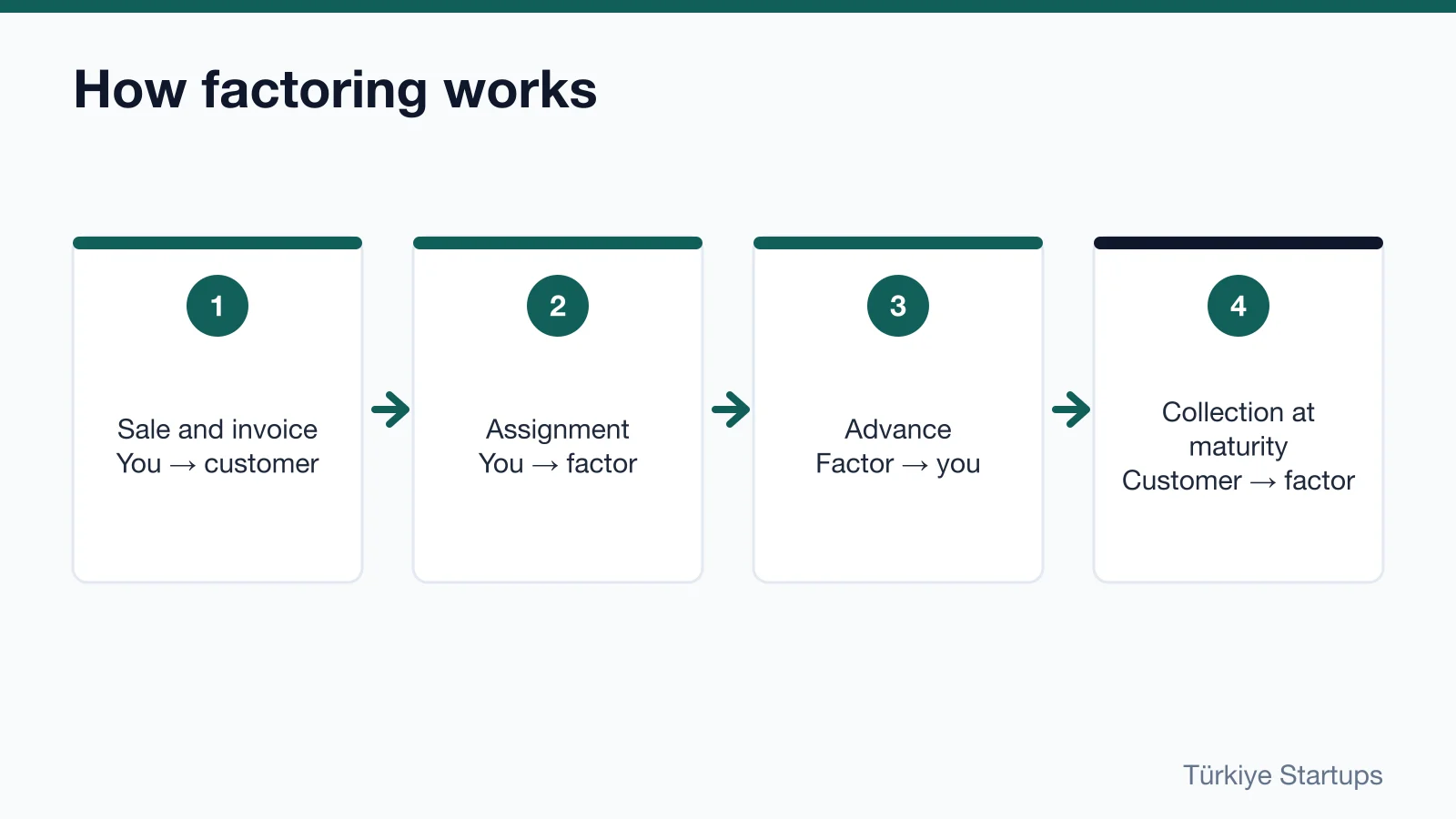
The process
- You sell and invoice.
- The factor assesses you and your customer and sets a limit.
- You assign the receivable with invoices, cheques or notes.
- The factor pays most of the amount upfront, net of discount and commission.
- Your customer pays the factor at maturity.
- Any balance is paid to you.
Types
| Type | Description | For whom |
|---|---|---|
| Recourse | If the customer does not pay, the factor reclaims from you | Most common; cheaper |
| Non-recourse | The factor bears the customer's payment risk | Those who want to offload collection risk; costlier |
| Supply chain finance | Suppliers of a large buyer get financing based on the buyer's credit | SMEs selling to large companies |
| Export factoring | Financing receivables from buyers abroad | Exporters |
See how to export for payment terms and export finance.
Documents
Company documents (tax certificate, registry gazette, signature circular), financial statements, receivable documents (invoices, delivery notes, contracts, cheques or notes), evidence of the trading relationship and the factoring agreement.
Cost
Mainly the discount (financing cost on the advance for the days to maturity) and the commission on the receivable, plus taxes (such as the banking and insurance transactions tax, BSMV) and fees.
Example (illustrative rates)
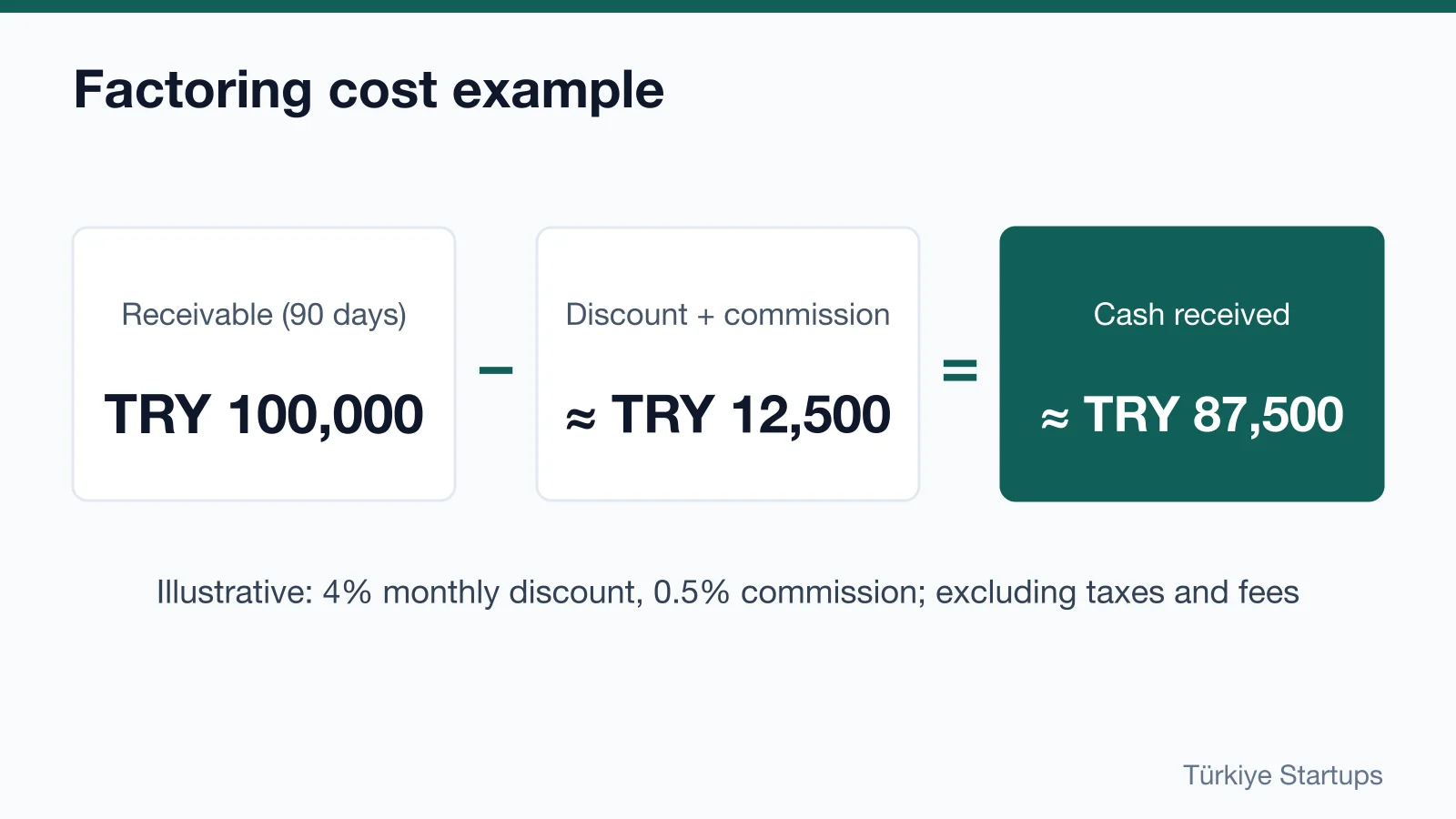
TRY 100,000 invoice due in 90 days; monthly discount 4%; commission 0.5%:
| Item | Amount |
|---|---|
| Receivable | TRY 100,000 |
| Discount (100,000 × 4% × 3 months) | about TRY 12,000 |
| Commission (0.5%) | TRY 500 |
| Taxes and fees | varies by provider |
| Approximate cash received | about TRY 87,500 |
Here about 12.5% of the receivable pays for 90 days of cash. Check how this fits your margin; see profit margin.
Factoring, loans or cheque discounting?
| Factoring | Bank loan | Cheque discounting | |
|---|---|---|---|
| Security | The receivable | Often extra collateral | The cheque |
| Balance sheet | Receivables fall, no debt (especially non-recourse) | Debt rises | Short-term funding |
| Speed | Fast once a limit exists | Slower | Fast |
| Whose risk | Largely your customer's | Yours | Drawer's and yours |
| Collection service | Factor follows up | None | Bank collects |
See financing with loans and cheques and promissory notes.
When it makes sense
When you sell on long terms to strong customers, grow fast, lack loan collateral, or want to transfer collection risk (non-recourse). It is expensive, though: if you always need it, renegotiate terms, offer early-payment discounts or revisit pricing; see cash flow management.
Common mistakes
Not annualising the total cost; forgetting the risk stays with you under recourse factoring; masking single-customer dependence; missing extra fees; using unlicensed providers.
Frequently asked questions
What is factoring? Assigning receivables to a factor to get cash before maturity.
Recourse vs non-recourse? With recourse, non-payment risk stays with you; without recourse, the factor bears it at a higher cost.
How is the cost calculated? Discount on the advance for the term, plus commission and taxes.
Which receivables qualify? Invoiced trade receivables, cheques and notes.
Are factors regulated? Yes, licensed by BDDK; use licensed providers.
Can startups use it? Yes, if they invoice corporate customers; the customer's credit strength matters.
Conclusion
Factoring closes the term gap and funds growth, but calculate its cost carefully. Use your customers' strength, compare offers and treat it as part of cash management, not a permanent fix. See also what is leasing.
This guide is for general information only and is not legal, financial or investment advice. Check official sources and consult professionals for current terms.