Commercial lease agreements in Türkiye: clauses to check before you sign
A guide for founders renting an office, shop or workshop in Türkiye: rent and increase rules, the deposit, withholding tax and VAT, term, renewal and eviction, subletting, licensing suitability, alterations and fixtures, stamp duty and a pre-signing checklist.
By Editorial Team

Renting your first office, shop or workshop is exciting, but the lease you sign shapes your costs and flexibility for years. A vague increase clause, premises that cannot be licensed or harsh eviction terms can seriously hurt a growing startup. This guide covers the clauses to check, tenant rights and tax points in Türkiye, useful for local founders and foreign companies setting up here.
This content is for general information, not legal advice. Rent rules and increase caps change; have important leases reviewed by a lawyer.
Before signing: do the premises fit?
Check that you can get a workplace licence for your activity and that there is an occupancy permit (see workplace licences); zoning (some commercial uses are not allowed in flats registered as residential); power, internet, ventilation and fire safety; the title deed and any power of attorney to confirm the landlord's authority; and building rules on service charges, hours and signage. If your needs are flexible, consider coworking or a virtual office first.
Key clauses
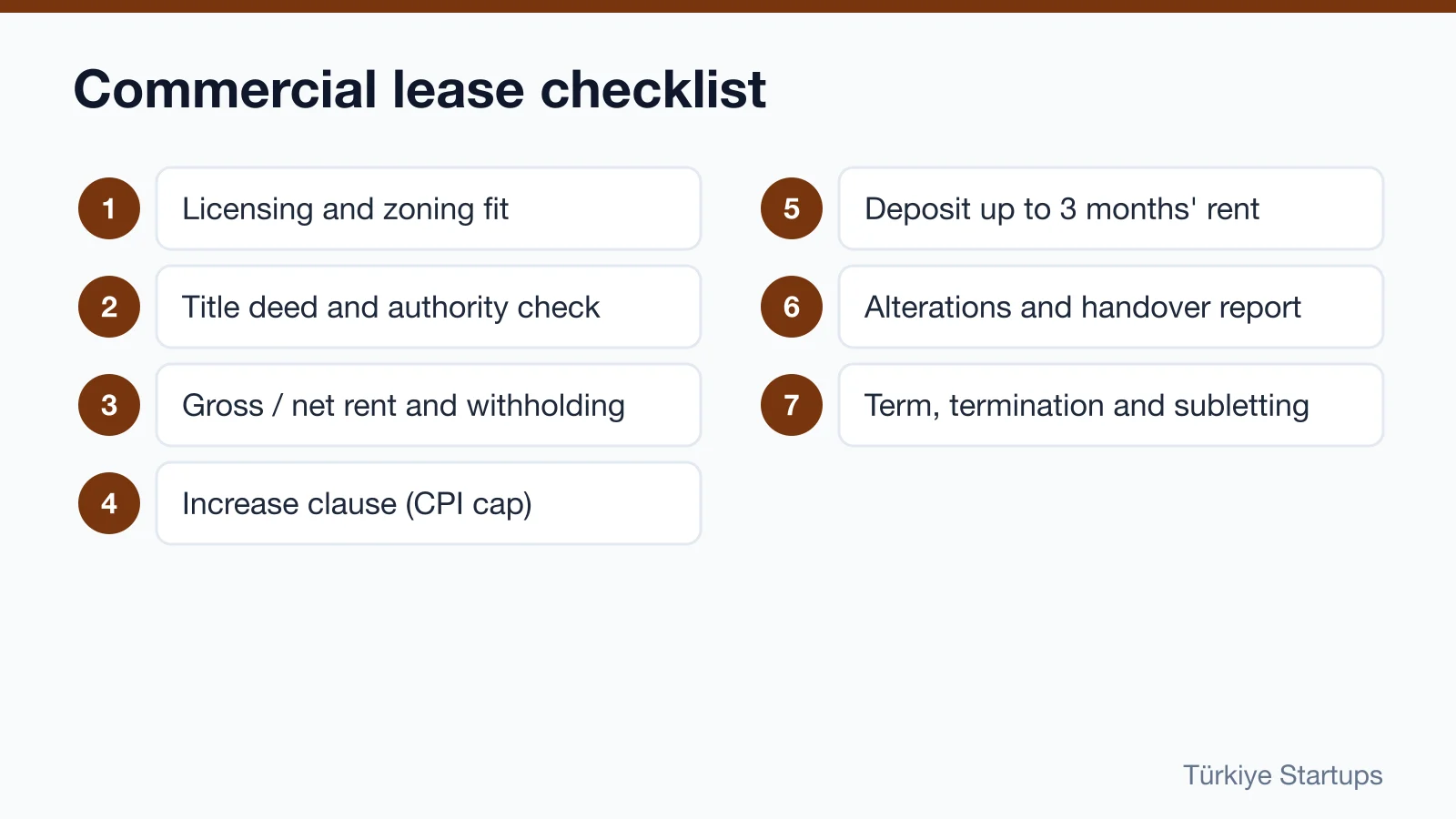
- Parties and premises: full details, address, parcel, size and permitted use.
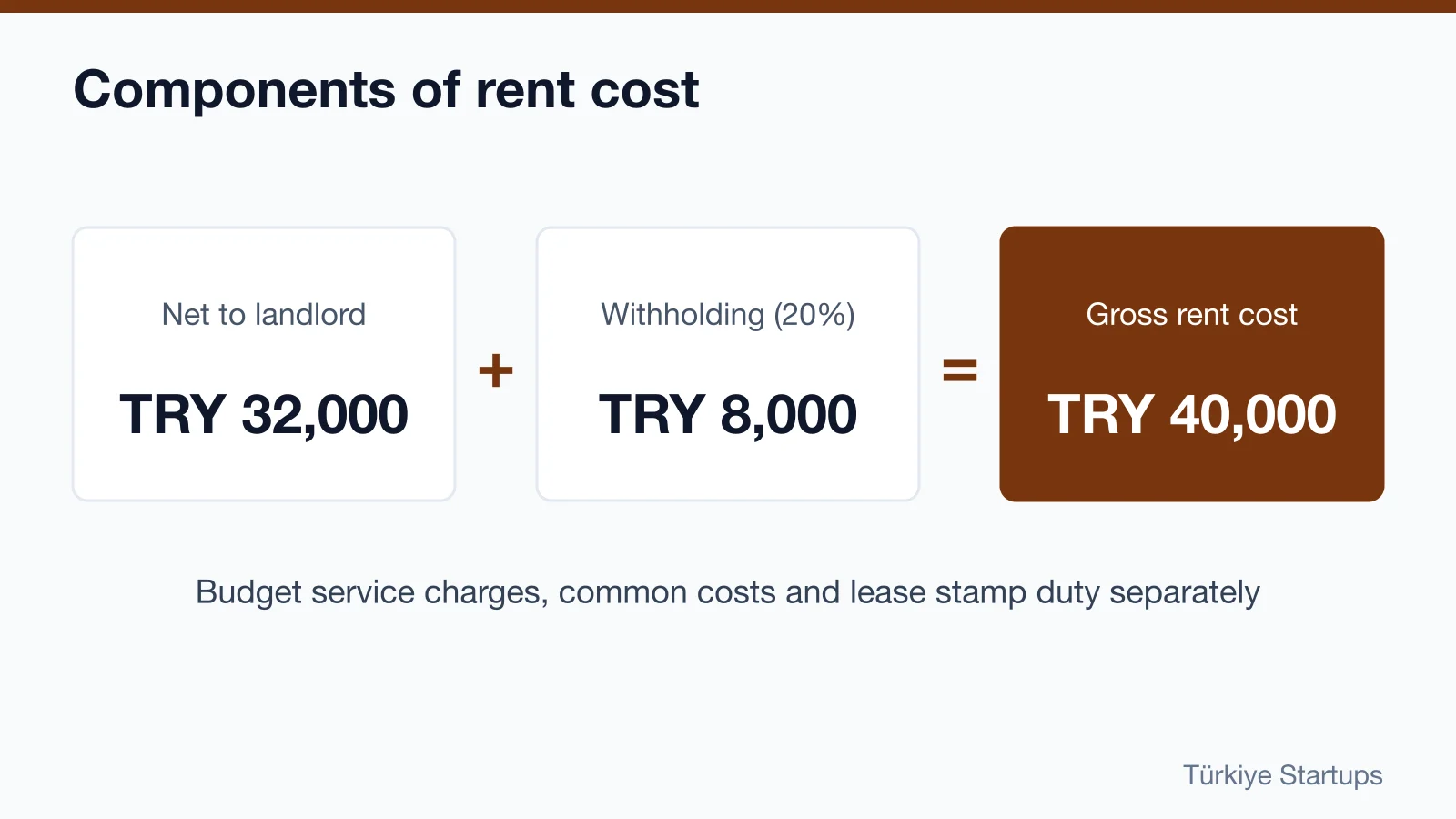
- Gross or net rent: a company paying an individual landlord must withhold tax, so state gross or net; VAT is added if the landlord is VAT-registered. See withholding tax.
- Rent increases: under the Code of Obligations, increases for residential and roofed commercial premises are generally capped at the 12-month average CPI change of the previous lease year; after five years rent can be reset to a fair level. State the formula clearly and check current rules. FX rents are possible but carry currency risk.
- Deposit: for residential and roofed commercial premises, the deposit cannot exceed three months' rent, and cash deposits go into a bank time-deposit account that neither party can withdraw alone. Write the return conditions.
- Term, renewal and termination: for commercial leases, a fixed term renews for one year unless the tenant gives at least 15 days' notice; the landlord generally cannot end the lease just because the term expires, but can after the ten-year extension period with notice. Define the tenant's early exit terms.
- Eviction undertaking: valid only if given in writing after handover; beware undated undertakings presented at signing.
- Subletting and assignment: for roofed commercial premises, not allowed without the landlord's written consent; write in shared use with partners or group companies.
- Alterations, fixtures and handover: written consent for alterations, who keeps improvements and whether you must restore at exit; record condition with photos and an inventory at handover.
- Costs: service charges, common area costs, property tax, insurance and major repairs; ordinary use costs usually fall on the tenant, major repairs and tax on the landlord, unless agreed otherwise.
Tax and formalities
| Topic | Note |
|---|---|
| Withholding | Company or merchant tenants withhold on rent paid to individual landlords and pay it via the monthly return |
| VAT | Added if the landlord is VAT-registered |
| Stamp duty | Due on the total rent for the lease term |
| Records | Pay by bank transfer with clear descriptions |
Common mistakes
Renting premises that cannot be licensed; no gross/net clarity; vague increases; cash deposits without records; no handover report; undated eviction undertakings; unwritten alteration terms.
Frequently asked questions
What is the rent increase cap? Generally the 12-month average CPI change of the previous lease year; check current rules.
Who handles withholding? A company or merchant tenant withholds from rent paid to an individual landlord and pays it to the tax office.
What is the maximum deposit? Three months' rent for residential and roofed commercial premises.
When can the landlord end the lease? Generally after the ten-year extension period with notice, plus special cases such as just cause or a valid eviction undertaking.
Can I sublet? Not without the landlord's written consent for roofed commercial premises.
Must a lease be notarised? No; a signed written contract suffices, but stamp duty applies.
Conclusion
A commercial lease sets long-term cost and flexibility. Check licensing upfront, clarify gross and net rent, and spell out increases, deposit, alterations and termination. See also choosing an office and, for foreign founders, setting up a company in Türkiye.
This guide is for general information only and is not legal, financial or investment advice. Check official sources and consult professionals for current terms.