How much should a founder pay themselves? Salary by stage, investor expectations and tax
A founder salary guide: whether to pay yourself, sensible pay by stage, the effect on runway, how investors see it, fairness between co-founders, salary vs dividends vs board fees, social security and tax in Turkey and when to revisit pay.
By Editorial Team

"How much should I pay myself?" is a question many founders think about daily but rarely ask. Too high shortens runway and worries investors; nothing at all strains personal finances, distracts and speeds burnout. Here is a practical framework. Tax and social security rules change; consult your accountant.
Why it matters
Focus (a founder who cannot pay rent cannot focus), sustainability over years (founder burnout), runway, and the signal it sends investors.
Pay by stage
| Stage | Typical approach |
|---|---|
| Idea, no funding | None or minimal, living on savings or side income |
| Pre-seed | Modest pay covering basic living costs |
| Seed | Clearly below market |
| Series A+ | Closer to market, usually still below |
| Profitable, mature | Market pay plus bonus |
The founder's main upside should come from equity; salary should simply keep them focused. Founders usually should not be the highest-paid people on the team.
Runway example
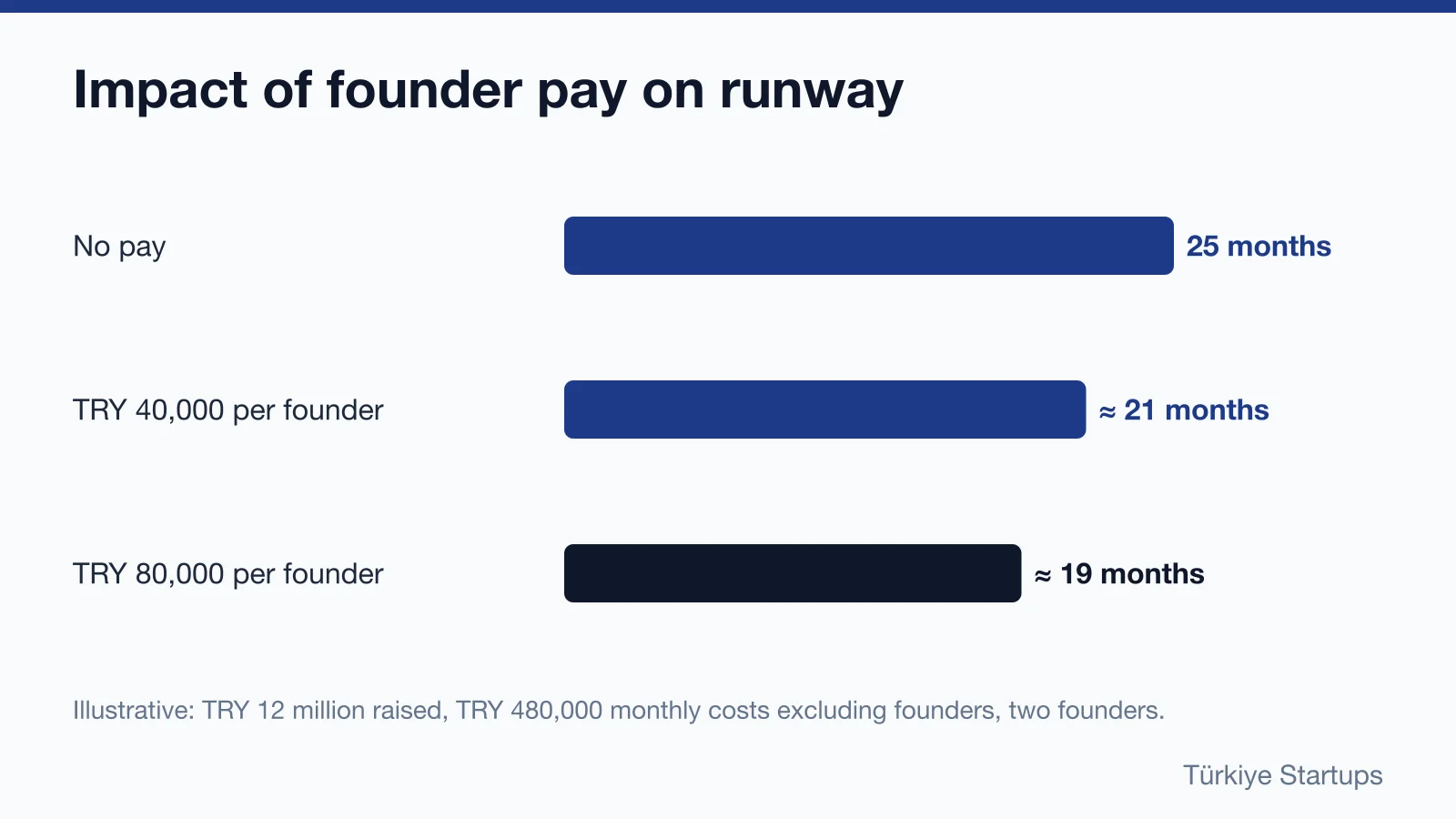
A startup raised TRY 12 million; monthly costs excluding founders are TRY 480,000; there are two founders.
| Scenario | Cost per founder per month | Total monthly | Runway |
|---|---|---|---|
| No pay | TRY 0 | TRY 480,000 | 25 months |
| Modest | TRY 40,000 | TRY 560,000 | about 21 months |
| High | TRY 80,000 | TRY 640,000 | about 19 months |
High pay costs about 6 months of runway. See cash flow management. Figures are illustrative total employer cost.
A framework
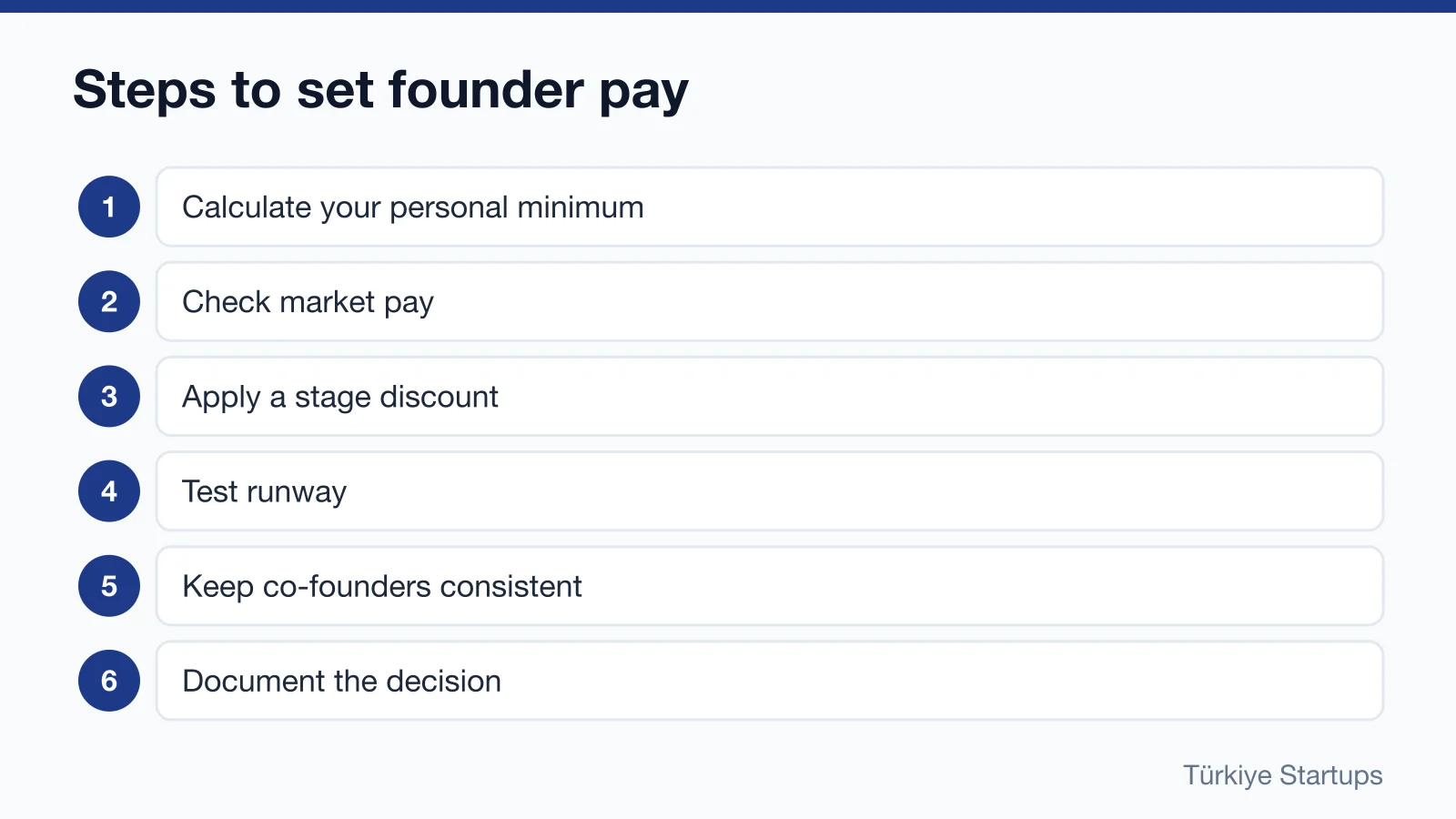
Calculate your personal minimum; check market pay for the role; apply a stage discount; test runway against the next milestone; keep co-founders consistent (explain any difference); and record the decision formally.
Investors' view
Reasonable post-funding pay is expected; raising pay far above market with investor money is a red flag; raises are usually discussed at board level and some deals include approval rights. See term sheets and boards.
Salary, dividends and board fees
| Type | What | For the company |
|---|---|---|
| Salary | Regular pay for work | Deductible; income tax and social security apply |
| Dividend | Distribution of profit | Not deductible; withholding may apply |
| Board fee (huzur hakkı) | Pay to board members | Often taxed similarly to wages |
Most early startups have no profit, so founders take salaries. See withholding tax.
Social security and tax in Turkey
Limited company partners and board-member shareholders of joint-stock companies are generally insured under 4/b (Bağ-Kur) (Bağ-Kur premiums); employment-contract cases can differ and need expert advice; compute total employer cost (employee cost); check incentives such as the young entrepreneur exemption.
When to revisit
After a funding round, on hitting revenue or profit goals, after major life changes, or when inflation erodes real pay, always against runway.
Common mistakes
Years of no pay and growing personal debt; jumping above market right after funding; unspoken pay gaps; irregular withdrawals instead of payroll; skipping tax and social security.
Frequently asked questions
Should founders pay themselves? If cash allows, a modest salary that keeps you focused is healthy.
How much? Depends on stage; early on, enough for basic living, below market.
Do investors weigh in? Usually through the board; reasonable levels are expected.
Dividend or salary? Depends on profitability and tax; model it with your accountant.
Are limited company partners on Bağ-Kur? Generally yes, under 4/b.
Equal pay for co-founders? Usually preferred; discuss any differences openly.
Conclusion
The right founder salary keeps you focused while protecting runway and investor trust. Know your minimum, match the stage, document it and review regularly. Meet investors on Türkiye Startups.
This guide is for general information only and is not legal, financial or investment advice. Check official sources and consult professionals for current terms.