E-signature and financial seal in Turkey: differences, how to apply and where they are used
A guide for founders in Turkey to the e-signature and the financial seal: what a qualified electronic certificate is, how e-imza and mali mühür differ, which one sole proprietors and companies need, how to apply, use in e-invoicing, e-ledgers and public portals, setup problems and renewal.
By Editorial Team
Two of the first technical needs after incorporating in Turkey are the e-signature (e-imza) and the financial seal (mali mühür). E-invoicing, e-ledgers, trade registry filings, public tenders and many official applications depend on them. Rules and fees change, so check the provider's and the Revenue Administration's (GİB) current notices before applying.
What is an e-signature?
A qualified electronic signature belonging to a natural person, legally equivalent to a handwritten signature. It is issued by electronic certificate service providers authorised by Turkey's ICT Authority, usually on a USB token; some offer mobile signatures. Uses: trade registry and MERSİS, public tender platform, government portals, contracts and, for sole proprietors, signing e-invoices and e-ledgers.
What is a financial seal?
The electronic certificate legal entities (limited or joint-stock companies) use to seal e-invoices, e-archive invoices and e-ledgers, issued under GİB procedures through the Public Certification Centre (Kamu SM) at TÜBİTAK.
Differences
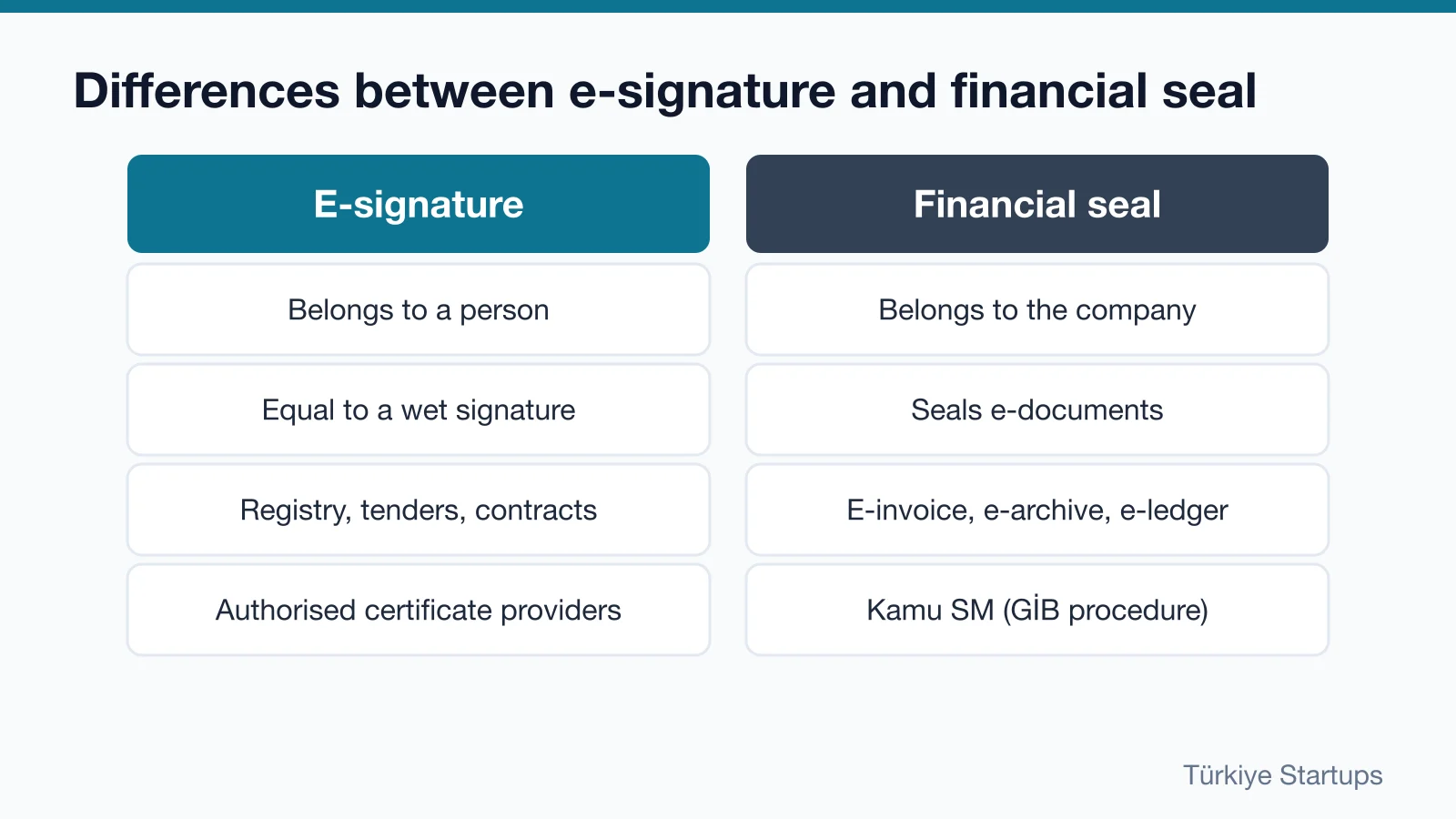
| Feature | E-signature | Financial seal |
|---|---|---|
| Belongs to | A natural person | A company or taxpayer |
| Effect | Equivalent to a wet signature | Seals e-documents on the company's behalf |
| Typical use | Filings, contracts, registry | E-invoice, e-archive, e-ledger |
| Issuer | Authorised certificate providers | Kamu SM under GİB rules |
| Sole proprietors | Can replace the seal for e-documents | Often not needed |
Who needs what?
- Sole proprietors: usually an e-signature is enough (see setting up a sole proprietorship).
- Limited or joint-stock companies: a financial seal for e-documents and an e-signature for the authorised officer (see limited company setup).
- Using a private integrator: you may be able to sign with the integrator's seal; confirm with your integrator and accountant.
Getting an e-signature
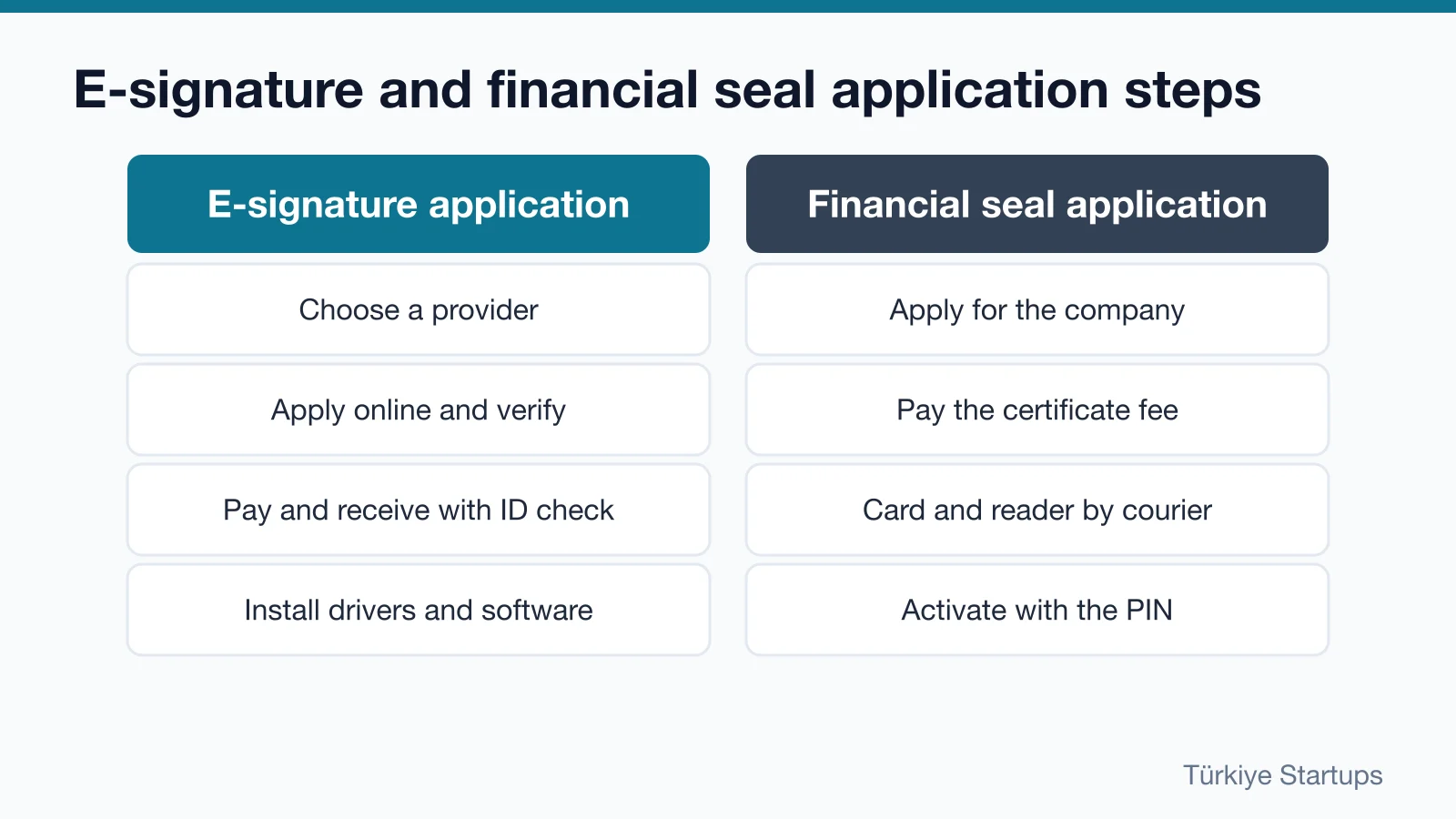
Choose an authorised provider and compare price, validity (often 1–3 years) and delivery; apply online with identity verification; pay; receive the token with an ID check; install drivers and signing software.
Getting a financial seal
Apply on behalf of the company through the GİB and Kamu SM process (typically using the officer's e-signature or e-Government); pay the certificate fee; receive the card and reader by courier; activate it with the PIN and use it to apply for e-invoice and e-archive.
Common problems
Unrecognised token (install current drivers); PIN lock after wrong attempts (PUK or support needed); expired certificates (renew before expiry); browser or OS compatibility on some portals.
Security
An e-signature binds you legally. Never share the token or PIN, do not store the PIN with the token, and revoke the certificate immediately if lost. See cybersecurity basics.
Cost and timing
E-signature prices vary by provider and validity; seal fees are set by Kamu SM and updated periodically. Allow from a few business days to a few weeks and plan with an accountant.
Frequently asked questions
Are they the same? No: the e-signature belongs to a person, the seal to a company.
Does a sole proprietor need a seal? Usually not; confirm with your accountant.
Does a limited company also need an e-signature? Yes, for the officer's official filings.
How long is an e-signature valid? Usually 1 to 3 years.
Can a mobile signature replace it? For supported services, yes, but not on every portal.
What if I lose the token? Report it and revoke the certificate at once.
Conclusion
The e-signature represents the person; the seal represents the company. Apply early in incorporation, track expiry dates and, once set up, create your profile on Türkiye Startups.
This guide is for general information only and is not legal, financial or investment advice. Check official sources and consult professionals for current terms.