What is a unicorn? Decacorns, soonicorns and startup valuation terms
The unicorn startup concept, terms such as decacorn and hectocorn, how a startup becomes a unicorn, how valuation is set, common traits of unicorns and criticisms.
By Editorial Team
In the startup world a "unicorn" is a privately held startup valued at USD 1 billion or more. The term was used by an investor in 2013 to stress that startups reaching this size are as rare as the mythical creature, and it spread quickly. Today every country tracks its own unicorns and these companies are seen as a sign of an ecosystem's maturity. In this guide we cover the unicorn concept, related terms, how valuation is set and the common traits of unicorns.
Key terms
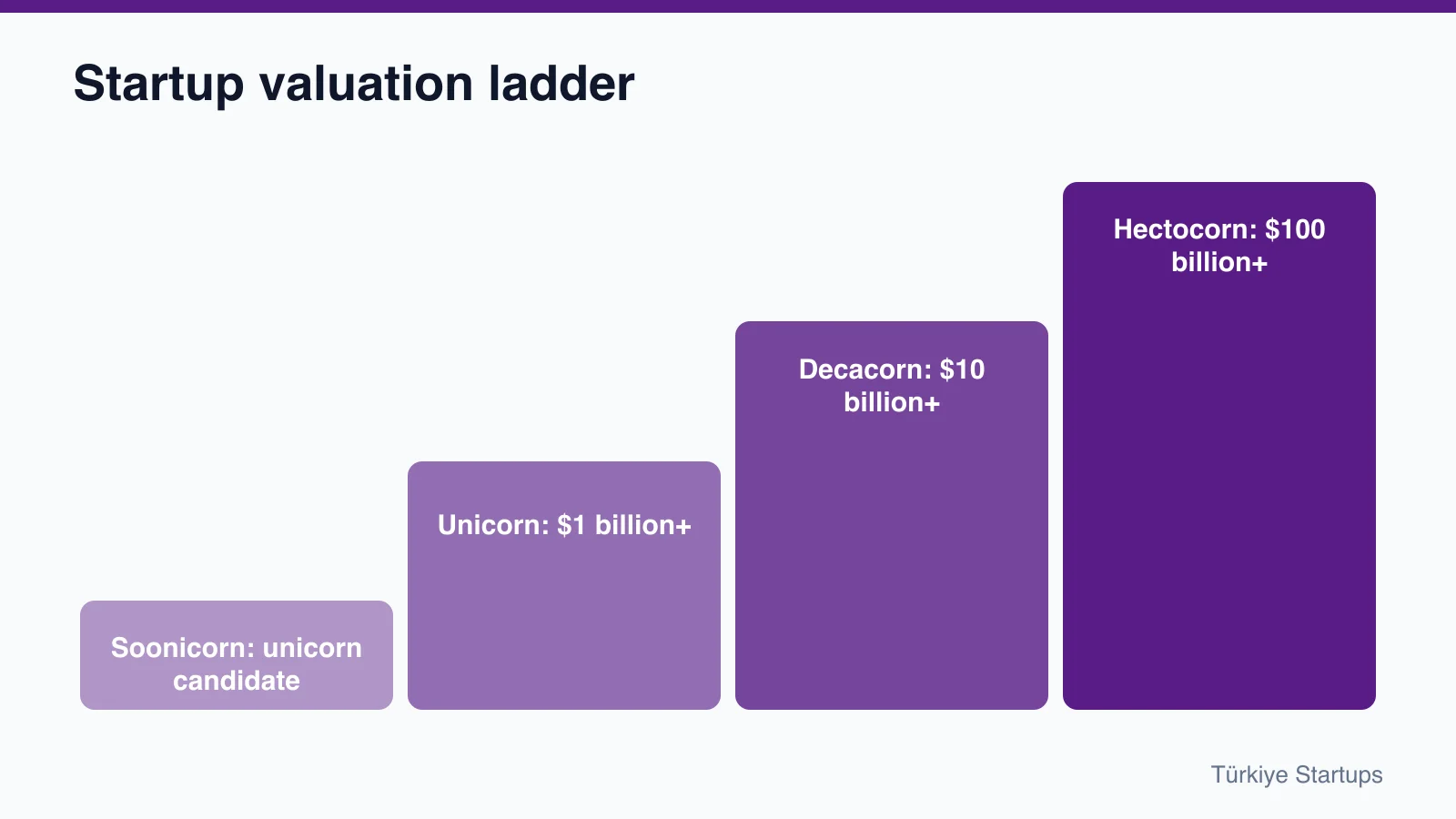
- Unicorn: A privately held startup valued at $1 billion or more.
- Decacorn: A startup valued at $10 billion or more.
- Hectocorn (super-unicorn): A startup valued at $100 billion or more.
- Soonicorn: A startup expected to become a unicorn soon.
- Minicorn / ponycorn: Informal terms for fast-growing startups, usually valued above $100 million, that are not yet unicorns.
- Zebra: An alternative concept for startups that prioritise profitability and sustainability over hypergrowth.
- Camel: Startups that endure tough conditions, use cash efficiently and grow in a balanced way.
How is valuation set?
Unicorn status usually rests on the post-money valuation set in a funding round. For example, if an investor puts $100 million in for 10% of the company, the post-money valuation is $1 billion.
Key points:
- This valuation is not what the company would sell for today but the price of the investor's expectations.
- Investment terms (rights such as liquidation preference) can make the valuation look higher than it is.
- Valuation can fall in later rounds ("down round").
For valuation methods see how to value a startup and for terms the startup investment glossary.
How does a startup become a unicorn?
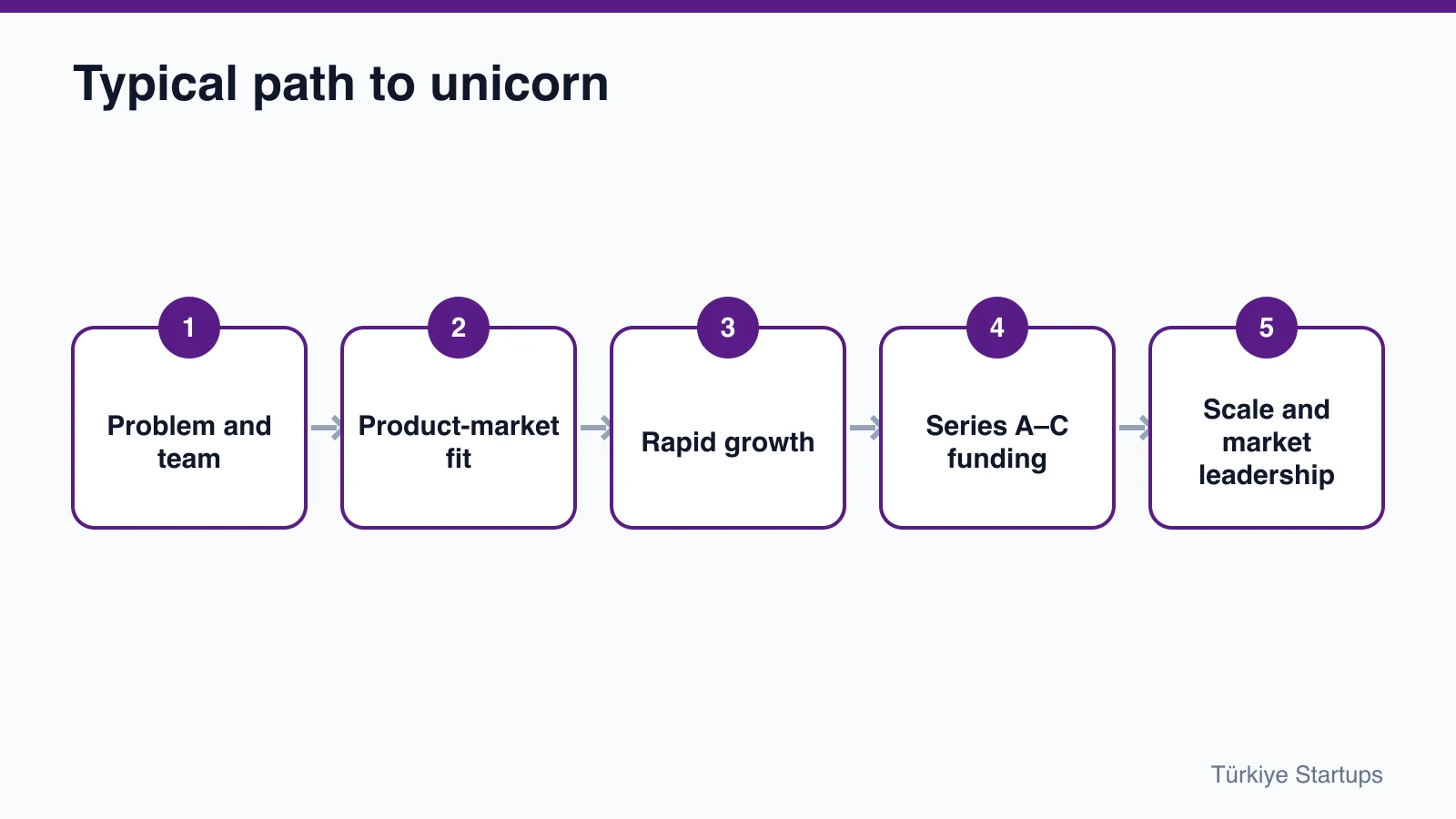
Every path differs, but a typical process is:
- A big problem and a strong team: An unsolved problem in a large market.
- Product-market fit: Customers using the product persistently; see product-market fit.
- A scalable business model: Revenue growing without costs rising at the same rate; see what is a startup.
- Rapid growth: Quickly gaining market share; see growth hacking.
- Successive funding rounds: Seed, Series A, B, C and beyond; see funding rounds.
- Market leadership and international expansion.
Common traits of unicorns
- A large, growing market: Billion-dollar valuations are hard in small markets; see TAM SAM SOM.
- Scale through technology: Software, platforms or network effects.
- A strong founding team and ability to attract talent.
- Network effects or a strong competitive advantage: Value rising as users grow.
- International vision: Looking beyond the home market early; see software exports.
- Access to investor networks.
Common sectors: fintech, e-commerce and quick delivery, gaming, software (SaaS), AI, health tech and logistics. See standout startup fields in 2026.
Türkiye and unicorns
In recent years Türkiye has produced startups reaching unicorn valuations, especially in gaming, e-commerce, quick delivery and fintech. These successes increased investor interest in the local ecosystem and inspired new founders. For the ecosystem's overall structure see the Turkey startup ecosystem guide.
Criticisms of the unicorn concept
- Valuation ≠ profitability: Many unicorns are not yet profitable; valuation rests on future expectations.
- Inflated valuations: In periods of abundant capital valuations can rise fast and then fall.
- "Growth at any cost" pressure: Cash burn and unsustainable models.
- Founder and employee stakes: A high valuation does not always mean a high return at exit; see the ESOP guide.
That is why "zebra" and "camel" approaches prioritising profitability and resilience have drawn interest in recent years; see growing without investment.
Takeaways for founders
- Becoming a unicorn is not a goal but a possible result of solving a big problem at scale.
- Not every startup needs to be a unicorn; a profitable, sustainable company is also a great success.
- When raising money, watch the terms as much as the valuation; see the founders' agreement and cap table.
- Do not neglect cash management and unit economics; see CAC and LTV.
FAQ
Must a startup be profitable to be a unicorn? No; the unicorn definition rests on valuation alone.
Are public companies counted as unicorns? Usually not; the term is used for private startups. They leave this classification after an IPO.
How long does it take to become a unicorn? It varies widely; some companies reach this valuation in a few years, others take more than a decade.
Conclusion
The unicorn is one of the best-known symbols of success in the startup world, but valuation is not the same as profitability and sustainability. Focus on solving a big problem in a scalable way; valuation is the result. To understand the investment process, see our how to find an angel investor and how a venture capital fund works articles.
This guide is for general information only and is not legal, financial or investment advice. Check official sources and consult professionals for current terms.