What is the Lean Startup? The build-measure-learn loop and how to apply it
Core principles of the Lean Startup, the build-measure-learn loop, MVP, validated learning, pivot decisions, innovation accounting and steps to apply it in your startup.
By Editorial Team
The Lean Startup is a method developed for building new products and businesses under uncertainty. Its core idea is simple: instead of building a product secretly for months and learning what customers think on launch day, get the smallest working product to customers quickly, measure, learn and steer accordingly. The method draws on lean manufacturing principles and the customer development approach, and since the 2010s it has become one of the core ways of working for startups and corporate innovation teams worldwide. In this guide we explain the principles of the Lean Startup and how to apply them in your startup.
Core principles of the Lean Startup
- Entrepreneurs are everywhere: The method applies not only to garage startups but also to new business units inside large companies.
- Entrepreneurship is management: An environment of uncertainty needs its own management approach.
- Validated learning: A startup's real progress is evidence-based learning about customers.
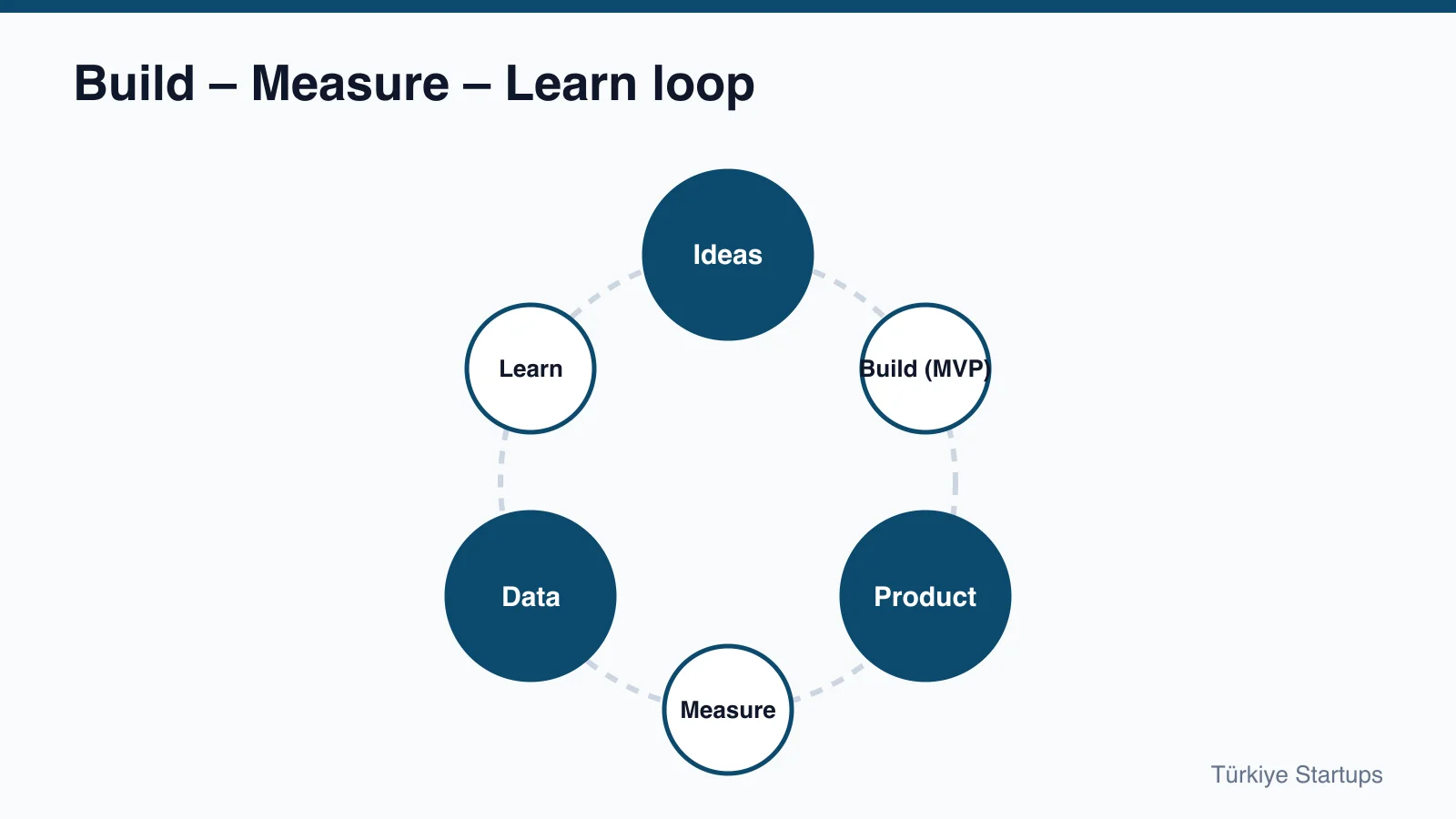
- Build-measure-learn: Turn ideas into products, measure customer response, learn and decide.
- Innovation accounting: Track progress with measures that show learning, not vanity metrics.
The Build – Measure – Learn loop
Build
Build the minimum viable product (MVP) that tests your hypothesis in the fastest, cheapest way. An MVP does not have to be software: it can be a landing page, a video, a manually delivered service or a prototype. See what is an MVP and fast MVPs with AI.
Measure
Measure real users' behaviour: sign-ups, usage, repeat usage, payment. Real behaviour matters more than survey answers. See data analytics.
Learn
Looking at the data, decide whether the hypothesis is validated: persevere or pivot?
The aim is to complete the loop as fast as possible; the shorter the loop, the more you learn.
Writing hypotheses
Every experiment should start with a clear hypothesis:
- Value hypothesis: Do customers really see value when they use the product?
- Growth hypothesis: How will new customers discover and spread the product?
Example: "At least 30% of small clinics keep using the online booking system on a monthly subscription after a free trial."
The Business Model Canvas is a good starting point for setting hypotheses.
Validated learning and innovation accounting
Vanity metrics (total sign-ups, total downloads) feel good but produce no decisions. Instead use:
- Cohort analysis: How users who signed up each week behave over time.
- Conversion rates: Movement between stages; see sales funnel.
- A/B tests: Measuring the effect of changes; see A/B testing.
Innovation accounting works in three steps: (1) measure baselines with an MVP, (2) tune the product to improve them, (3) if there is no progress, decide to pivot. For the right indicators see the KPI guide.
Pivot or persevere?
A pivot changes part of the strategy while keeping the vision. Types:
- Customer segment pivot: The product creates more value for another audience.
- Problem pivot: The really painful problem is different.
- Zoom-in pivot: A single feature becomes the whole product.
- Revenue model pivot: Such as moving from one-off sales to subscription.
- Channel pivot: A different sales or distribution channel.
Hold regular (e.g. monthly) "pivot or persevere" meetings. See what is a pivot.
Steps to apply the Lean Startup
- Write your business model as hypotheses (canvas or Lean Canvas).
- Pick the riskiest assumption.
- Talk to customers; see customer interviews.
- Design the smallest MVP that tests this assumption.
- Set the success criterion in advance.
- Run the experiment and measure.
- Decide: persevere, pivot or stop.
- Record what you learned and repeat the loop.
Common misunderstandings
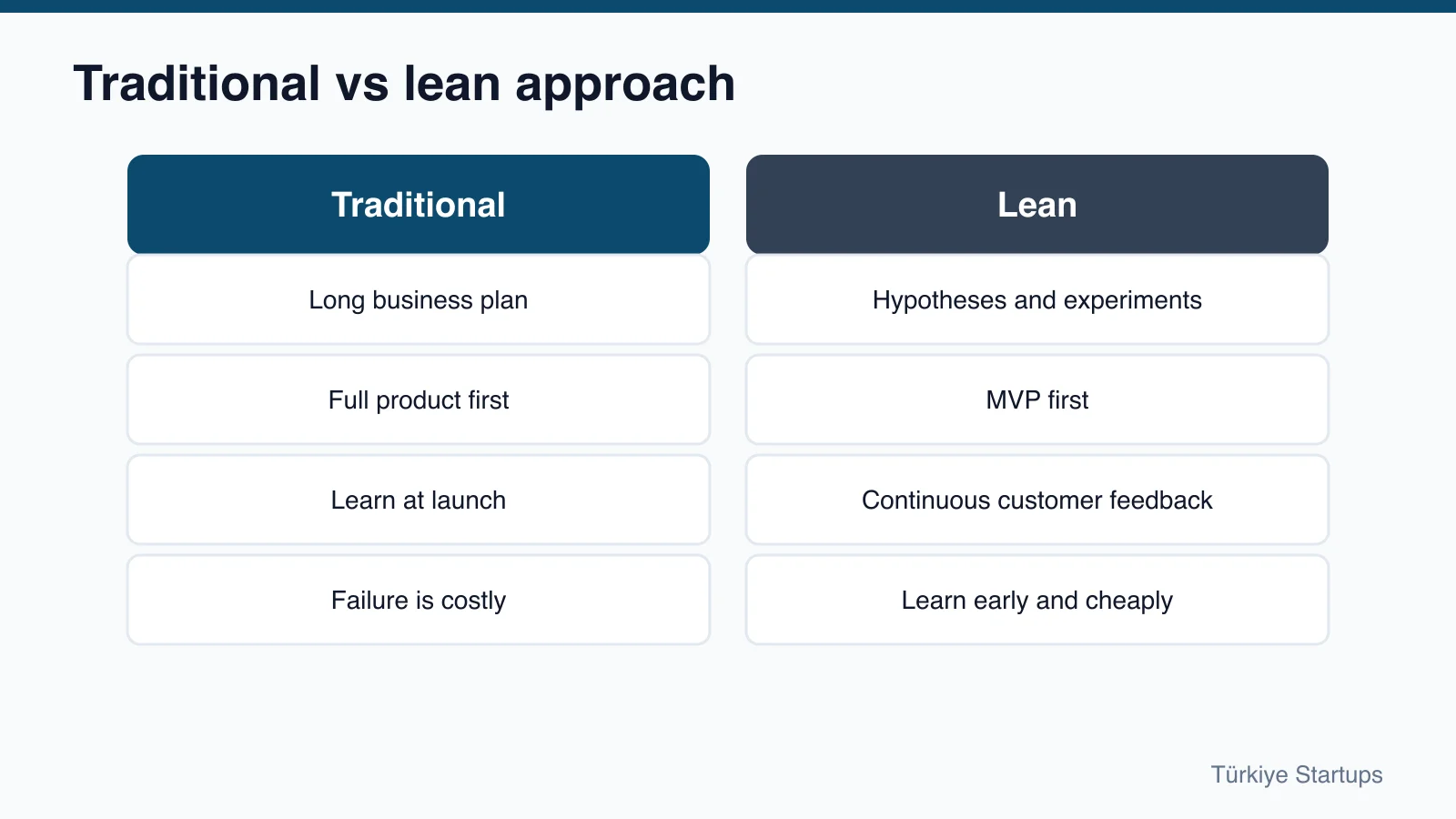
- "Lean = cheap, low-quality product": An MVP is focused, not shoddy; it should deliver the value it tests well.
- "No need to plan": Lean is not planlessness but treating the plan as hypotheses and testing it continuously.
- "Constant pivoting": Pivots are made with data; it is not changing direction at every difficulty.
- "Only for software": It is also applied to physical products, services and corporate projects.
The lean approach in corporates
Large companies also apply lean methods by testing new business ideas with small teams, limited budgets and clear experiments. For corporate transformation see corporate AI transformation and SME digital transformation.
Relation to design thinking
The Lean Startup focuses on "testing the right thing fast", design thinking on "deeply understanding the user's real need". Together they form a powerful innovation process; see design thinking.
FAQ
Is the Lean Startup suitable for every business? It suits any new product or business with high uncertainty; its effect is more limited for businesses applying a known model.
What is the difference between an MVP and a prototype? A prototype is usually for internal testing; an MVP is the smallest product released to learn from real customers.
How long should a loop take? As short as possible; at an early stage aim for a few days to a few weeks.
Conclusion
The Lean Startup is a method that reduces waste under uncertainty, speeds up learning and helps you reach the right product with fewer resources. Write your hypotheses, test them with the smallest experiment, measure real behaviour and decide on the data. To start applying it, see our startup idea validation methods guide.
This guide is for general information only and is not legal, financial or investment advice. Check official sources and consult professionals for current terms.